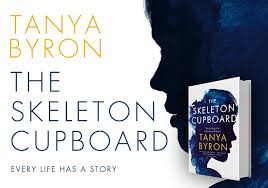
Many of us are familiar with Tanya Byron from her work as a TV psychologist, or from her regular columns in Good Housekeeping and The Times. A respected academic, she advises governments on issues relating to children, young people and mental health, and now she has drawn on her extensive background in the area of mental health to write a work of fiction ‘The Skeleton Cupboard – the making of a clinical psychologist’.
The Skeleton Cupboard opens by telling us about the author’s violent introduction to the concept of frontal lobes at the age of 15. Brutal and shocking, this part of the story deals with the murder of her grandmother, and represents the point where she first became fascinated by mental health as it affects every one of us. This chapter is the only one of the book which details a real life experience; from here on in, the book becomes a fictionalised account of the training placements undertaken by Tanya’s on her journey to becoming qualified. In the words of the author,
‘[The characters] are constructs, influenced by the many incredible people I had the privilege of meeting during my training. I dedicate my book to them.’
We are then taken through six case placements in diverse settings, ranging from a psychiatric unit for 12-16 year olds, to a GP surgery, to an older persons’ residence. Each placement brings with it its own challenges and the author does a good job of portraying these in a realistic fashion, whilst at the same time charting her growing confidence – and occasional over-confidence – in dealing with situations arising. The story also depicts an initially tricky relationship with Tanya’s academic supervisor, which develops into a mutual respect, and as we learn in the book’s epilogue, an enduring professional relationship.
Although the backbone of the story is the author’s journey to becoming qualified, the real flesh on the bones comes from getting to know the diverse characters Tanya meets within each placement. All of these people have stories to tell – some are heartbreaking; some are heartwarming; some are tragic and not all have a happy ending:
‘Paul taught me that my rescue fantasies were my problem. He was my professional salvation. You can’t save everyone. Rescue fantasies are just that; they’re fantasies.
Some people you can’t save.’
The story also informs us about how attitudes to – and treatment of – mental health issues have changed over the years – and raises valid questions about the accepted view that institutions are automatically an inhumane way to treat those with serious mental health problems, as opposed to caring for them in within the community.
‘It was about de-institutionalisation; patients were put on ‘social skills’ programmes in order to one day blend back into the community – a community that just did not bloody care and was frightened by and could not tolerate difference.’
The over-riding message of the story is that we are all, more or less, touched by mental health issues in some way – and this is brought home by some of the very ordinariness of the characters we meet and the lives they lead. In addition Tanya’s supervisor Chris suffers her own breakdown part way through the story, but we are also shown her coming back to work and continuing with her highly successful academic career; the clear message being that nobody, not even a ‘brilliant supervisor…one hard-core, fiercely intelligent, no-nonsense woman’, can consider themselves immune from mental ill-health at some point in their lives. A point that is made again with the last words of the book:
‘I will end now by re-iterating that none of these people I have written about in The Skeleton Cupboard exist; I have betrayed no confidence by telling their stories.
But then again, I would suggest, and forgive me for leaving you with this, that they actually do exist – bits of them exist in us all’.
I found The Skeleton Cupboard to be an engaging read, easy to get into and follow, despite the complexity of the subject matter. The book deals with a difficult subject, one that is still not as openly discussed or accepted as it should be, but it does so in a non-threatening and unpatronising fashion. I would definitely recommend this book – if you have an interest in psychology there is plenty to fascinate you; equally, if you don’t think mental health issues are any of your concern, reading the book may open some interesting doors onto the subject.
**Disclosure – I received a free copy of this book from Mumsnet and PanMacmillan Books, in exchange for writing a review. I have not been otherwise recompensed for this post, nor have I been asked to say anything specific in the review.**
Like this:
Like Loading...


